
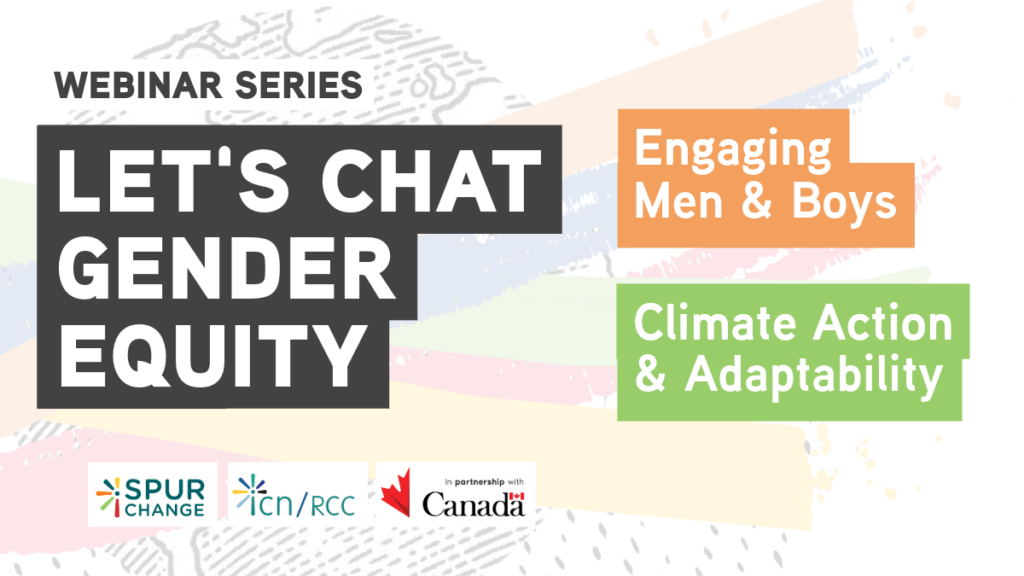
Let’s Chat: Gender Equity

In the fall of 2025, Spur Change invited small and medium-sized organizations (SMOs) to take part in a conversation series on promoting gender equity in international cooperation. This community discussion series was centered on gender equity through an intersectional lens and aimed to be a knowledge sharing moment focused on SMOs sharing new ideas and examples on how to implement gender innovative strategies across projects.

Session 1: Gender Equity and Engaging Men and Boys

In the first session, hear from organizations on the importance of engaging men and boys in GE projects to create sustainable change.


  • Darcy Ataman, Make Music Matter, presented their Healing in Harmony model: a gender-transformative approach that engages men and boys and helps them process trauma, redefine masculinity, and build healthier relationships.
  • Kamilla Pinter, HealthBridge Foundation of Canada, spoke to the important role of including men to improve sexual, reproductive, maternal and child health (SRMCH) in a community and how this can help challenge underlying inequities.
  • Caroline Pugeni, Score Against Poverty, presented the Men Can Cook initiative: a transformative approach anchored in cultural respect, safe community dialogue, and role modeling that engages men and boys in household nutrition and care.

Session 2: Gender Equity, Climate Action & Adaptability

In the second session, explore how advancing gender equity and climate action are more connected than you might think and learn how women leadership is playing a frontline role in strengthening a community’s climate adaptability.


  • Ahumuza Ronah, Holistic Actions for Development and Empowerment (HADE), spoke to HADE’s approach to enhancing women’s leadership in climate adaptation and strengthening the resilience of climate-sensitive communities through creating green, women-led co-working spaces, an Urban Recycling and Skilling Academy, and other projects.
  • Ann Thomson, SALASAN Consulting Inc., presented the Climate Leadership and Action for Indigenous Women in Nepal (CLAN) project which aims to build local climate leadership and gender-inclusive capacity through supporting indigenous women climate leaders and inclusive gender-sensitive climate education.
  • Nicolas Mbengue, Cégep de la Gaspésie et des Îles, shared insights from the implementation of the Ecosystem Solutions for Sustainable Adaptation project. The project implements nature-based solutions, under the leadership of women, to strengthen community environmental skills and climate change adaptation plans. His presentation also addressed aspects related to strengthening women’s economic power, which remains important for strengthening climate resilience.